Decolonize tech
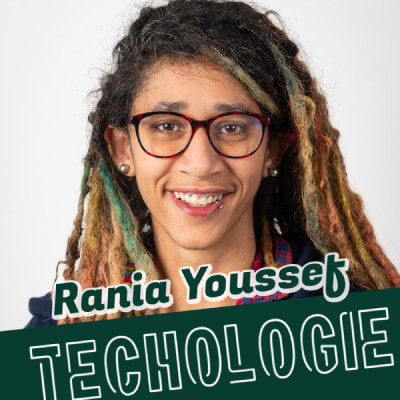
Rania Youssef
Episodes > published on 10 Mar 2026
Decolonizing the digital world is a topic that still receives little media attention and is rarely explored, even here on this podcast. We had the opportunity to discuss this subject with David Maenda Kithoko about four years ago on Techologie (episode 67), and he explained the connection between wars, deaths, rapes, and the smartphones in our pockets. It is important to consider more generally the decolonization of ecology, especially here in the global north. Let's continue exploring this topic with Rania Youssef, a Back End Developer, queer activist and founder of Tribe-X in order to decolonize tech.
By listening to this episode, you will download 20 MB of data.
En savoir plus
Transcription
Extrait
We were talking about how big tech is contributing to genocides all over the world. All over the world. And you can see the whole entire supply chain for tech from the beginning of extracting the resources to the end of where these technologies are being used, applied and tested on. The whole thing is exploitive.
Rania, you are an Egyptian, backend developer, queer activist and founder of Tribe-X in order to decolonize tech. So before we talk about your current activities and Tribe-X, can you please tell us your personal story?
Hi, I'm Rania. I've been a backend developer for the last four years. And then I focused more on Tribe-X. But also, I'm an Egyptian refugee and a single mother living in Paris.
So actually, I was interested in technology because of my dad. So my dad was one of the earliest people that did Visual Basic and they were doing Excel sheets. And he wanted to help the accounting in his company because he was working at the only cigarettes company in Egypt, that's Eastern Company. And he just started playing with the Excel sheets and making the equations better and make the roads for where the cars are going to distribute the cigarettes, have better equations so they can do it better. And I just fell in love with how he was doing it and how he was repeating the equations.
But after that, of course, I became a single mother at the age of 21. So it was almost impossible to really follow your dreams when you're a mother and a single mother, a woman in tech. So I couldn't get into tech until I actually managed to come to France as an LGBT refugee here.
What problems do women, people of color, queer people face on the internet or in the digital companies?
It's a really, really good question because actually all of the problems, all these groups really intersect in a lot of problems. And I can really the core of it, the radical core of it is colonialism. And how is that being shown in the tech industry is basically by seeing how homogeneously it's ruled by white, cis, hetero, mono men.
And this is the core of the problem. The problem is that it's not made by us nor made for us, not inclusive for us. It's not it doesn't have any space for anybody except white, cis, hetero, male men that have a lot of power and a lot of money and a lot of privilege. And the ultimate currency, which is what we all pay, it's time. They have time to be able to learn and sit down. Most of the time, even if they have kids, they have the wife that's taking care of the kids while they do coding. They don't have families to take care of, like which is very common when it comes to people of color or black and brown mothers or black and brown women.
So it's not made for us. You don't really go to a tech company and find kids area, for example, which you could find in other industries. You could maybe go to education system and you can find maybe babysitting services for mothers, but you don't find that. The homogeny of it, how transphobic, homophobic and sexist it is, the code in itself is biased. Everything about the code that we're creating is biased, written in their image.
We know how technology started in Silicon Valley and by all of these CEOs. And I remember there was a story about how Mark Zuckerberg, when he created his first bank account and the woman didn't understand so much what he was speaking about. And he's like, I'm a CEO, bitch, you better do this account. I'm like, OK, this is the image of we are living in a fantasy of a white men, cis white mono hetero men industry.
And tech is very violent for all these groups, for queer groups. It's very transphobic. It's very homophobic. It's very sexist. It's very racist as well. We know that there are biases in the code when it comes to AI, when it comes to facial recognition, when it comes to HR hiring, when it comes to naming. So everything about it is biased. And you can really trace all these issues to colonialism and white supremacy.
### So I said you are a founder of this company or NGO. So what is the status of Tribe-X and what activities do you offer?
So Tribe-X is an association. It's an NGO. So it's nonprofit. And what we're trying to do is we're trying to create a movement to decolonize technology, to rethink the entire tech industry, really.
And we put the activities in three goals or four goals. So the first goal is education. And we don't want to even say education. We want to say transfer of knowledge because education still has a little bit of hierarchy. So the education or transfer of knowledge, which is our conference, Alternative Worlds. We're trying to work on also our own podcast that is for the margin people to have their voice in the tech. We're trying to write blogs and magazines to talk about the intersectionality of discrimination in the tech industry.
And then the second objective, which is creation. Creation, which we are creating alternative tools to current technology that we exist and making sure that the people that take the decisions are the people that are at the margin, not people that are on top, not people that are already situated in society.
The third objective, which is migration. So we do individual one-on-one basics, easy video call or even bring your laptop to us. And we help people migrate their services and their tools from big tech to smaller companies. And sometimes it can even take months of explaining what we're doing. And it doesn't matter. We're going to take it as slow as possible, one computer at a time, one laptop at a time.
And the fourth objective, which is a little bit hidden. It's more to build a bridge between the decolonial activists and the tech creators, which is the tech ecosystem. I feel like, from my experience, the decolonial activists are not really in the same sphere and ecosystem as the tech creators or the tech activists as well. And we want to build the bridge between them by all this stuff we do.
Can you tell us more about Alternative Worlds events?
Okay, so it's my baby. I love the conference so much because it brings all the intersectional marginalized groups in one place. Let me tell you the story. So I went to Vivatech. Yeah, exactly. I went to Vivatech and my heart was like, oh, my God. I felt like my heart was really broken because you can see where the funding is going away from. In Vivatech, you see where the money is and you can see that this money is being taken away from education. It's being taken away from health care. It's being taken away from migrants and refugees budgets of integration or whatever they want to call it ethically or not ethically. But it's taken away from people's budget.
So Alternative Worlds is supposed to create an alternative ecosystem for tech. So we talk about the intersectionality of discrimination. We talk about the topics of Sudan. The last conference, it was about Palestine and Congo. We were talking about how big tech is contributing to genocides all over the world, all over the world. And you can see the whole entire supply chain for tech from the beginning of extracting the resources to the end of where these technologies are being used, applied and tested on. The whole thing is exploitive. So this is what we talk about in the conference. We try to open these topics in them.
The next conference, we're going to talk about the intersectionality of sex work, for example, and big tech. We talk about pink washing in the tech industry and how is this affecting everybody? We need to bring all these groups together.
Also, the other thing is we have an eco market which has human technologies, which is technologies that are made by handmade, slow technologies that are by people, by refugees. Most of the time, refugee women that are have been here and they have the small businesses that they need support. So you find them in the conference as well.
I always insist on space for kids. So any event for Tribe-X, it always has space for kids, super important, cannot exclude all the parents that exist in the world. And most of the parents are mothers that end up with the care.
And also, there is always a queer side. So there's always at the end either a drag show or something because our comedy show the last time there was amazing friend that was doing his Palestinian and he does stand up comedy. It was really great because you could see how even jokes in the tech industry is a little bit scary or saying bad words. It gets you out of the professionalism. So I'm there to pop this bubble of tech is only for the niche elite people, very professional with the have the tech code and bring it to earth because all of us use technology. All of us is participating in this. All of us are part of it.
So our next event is the 21st of March, which is a very important day. It's the Nowruz, the beginning of the Nowruz, which is the celebration for the beginning of spring in Iraq and Iran. And also, it's the Mother's Day in Egypt. And also, I think it's the day against racial discrimination as well in the world. So it's really great. We're going to have workshops, migration workshops, as usual, the eco market as well.
And at night, it will be a queer party. So we're going to have a lot of shows and workshops and it's going to intersect. And we're super excited and we are inviting everybody to come and join the workshops and to watch the artists. So it's going to be the whole day. So it's going to be from 12 p.m. till 12 at night. And it's going to be in one of my favorite places, The Wrong Side, which is near Porte de Clignancourt, Paris. I'm probably not pronouncing it right, but it's good. And yes, you can come anytime. There's the workshops that are going to be. You can have lunch there. It's open space. The eco market is from 12 to 12. The party is at night, probably starting from six. And the workshops are going to be going throughout the whole day.
Richard : I know the wrong side. It is a restaurant, it is a third place with very good food, Palestinian or Arabic food. Very, very good. So it is a very good place in Paris near Porte de Clignancourt.
So Rania, I suggest we move to a new part in this podcast. The quick questions. I have some questions to you, but you answer only with one word.
1. Can we stop communicating with loved ones just because it's on WhatsApp or Facebook? Yes or no?
No.
2. To be queer friendly, all you have to do is repaint your logo in rainbow colors once a year. True or false?
No, no, don't do it only once in a year. We can see you. Don't do that.
3. Hiring people of color in tech is good because they can be paid less. True or Unfortunately, in reality, it's true.
I hate it. I hate this question. I hate it. Unfortunately, it's true, but don't do it.
4. Decolonizing the digital world means first and foremost having digital sovereignty. True or false?
True. If we have the same meaning for sovereignty.
Do you want to explain this, about sovereignty, the meaning for you?
Sovereignty should speak more about digital divide, about how different people use technology and also speak about how we don't own the technology we're using. It's not coming from us. So it's not really we're at the end of it. So we need all tiers and hierarchies inside the tech to be working together. This is we cannot pass to decolonization of technology without going through the steps of addressing digital divide, addressing poverty, addressing all these problems in the society. And why is technology giving us all of this?
Another topic: in France, we talk about digital de-escalation (désescalade numérique). How from the perspective of someone from the global south can we find intersections between decolonizing tech and the concept of de-escalation or de-growth?
OK, my problem with the word de-escalation is I feel like it's disconnected from my world because we're already at the end of we don't have tools. We're not accessing the proper tools or even using the tools that we want to use. And I feel like it's really not relevant. There is a word. I can't pronounce it because in Arabic it's called taqashuf. We're already at this phase, austerity. We're already at the end of this taqashuf. We're already there. We don't have technology for us to come for people to come to us and tell us decrease your use. We don't know. We don't own it. It's not by us. It's really disconnected from my world.
And I feel like the question should be more about how can we gain autonomy over the tools? How can we create our own tools? How can we have sovereignty? How can we close the gap of the digital divide? Because when you also look at electricity use, electronic use, any of this use, you still have Africa and the global south or South America. We're still at the least consumers of usage of the electricity or electronics. It's still not a big deal. Like it's very difficult for me.
I've lived in the Bedouins in the desert with the Bedouins in the desert in Sinai when I was in Egypt. And they charge their phones with the car battery every night. I'm like, what is the concept of decreasing technology for them? What do I tell them? It's so far away from them. So I feel like it's not our question.
We need to really, really focus on closing the gap of the digital divide. The other problem that I see with the decreasing of technology, I feel like it's also top to bottom.
But yeah, aside from the disconnection that I feel from my world, we need the autonomy. We need that's it. We just need the autonomy over our own tools. We create them. We need to take emancipation. Absolutely. Because we're really at the end of it. We're not creating it.
And there was somebody that I heard that was speaking about that most of the time when the West speaks about how technology is used, they're only talking about the colonial aspect, which is kind of like: oh, technology is going to be used against us the same way we have been using technology against people. But if you go to the to the global south, if you go to Sudan, it's not in their brain to create an application that creates massacres or genocides, for example. It's not on it's not what they want to do with the technology. They just want to create a CV. They want to find a recipe or translate the text. So even the usage and the freak out of how technology is, is different between the people that are at the end of users to just users of technology and people that are creators of these technologies.
Richard: The degrowth is the first of all for the rich people, for the West, for the global north, not for the global south. But OK, it was very interesting to find the intersection. But there are no very intersection with what global south are living all the day.
I know there's a cause close to your heart, Palestine and the ongoing genocide in Gaza. You have the keffieh on your shoulder. Always. How does techno capitalism contribute to this colonial destruction?
It's pretty scary, actually. It's really, really, really scary. And it's not just capitalism, it's colonialism and it's all they built the digital infrastructure of apartheid. This is what the US and Israel have done. The Zionist entity have done. They built the the digital infrastructure of apartheid. How maps can separate between the maps for Palestinians are not the same maps that you can use for the Zionist.
And as an Egyptian, I've seen Pegasus being used as it as against Egyptian activists. And that was way before the 7th of October. That was way before the acceleration of the genocide that now we're being we're watching, it televised. Pegasus is a tracking malware. So basically that they put it on the activist phones and they can get all the information and you don't even need to download anything. It's just you get the malware on your phone and it tracks your messages on WhatsApp, Facebook, your location. And it has been used against a lot of activists and dictatorships. And that is a Zionist technology. That's a Zionist service. And that was they have something called the Silicon Wadi, which is the same version, similar version of Silicon Valley. It's a bit a bit weird every time they appropriate the Arabic names, which is Wadi, which is Wadi = Valley. They translated it.
But after Pegasus here as a refugee as well, I've seen that that the European Union has been using Zionist / Israeli technologies to control the migrants and the refugees. And you see that in the Dublin agreement. Where's all our data is going? Where's all these fingerprints are going? Where's all of this being saved? It's being saved on servers for the US, by the way. So I don't understand what Europe has been doing. Just let's give the data to the US.
But with this infrastructure of apartheid, it's being sold everywhere in the world. And what it's going to create, what it's creating right now, it's creating the term global Palestine. Whatever that has been done in the Palestinians, whatever that has been tested on Palestinians by big tech, by Zionist tech services is being exported all over the world and it's being applied everywhere in the world. The digital IDs, they were already tested on Palestinians when they separated the IDs between people from the West, people in Gaza and people that are under the occupation, under the occupied land. They did that with the facial recognition. They can track so many people by lavender AI. Lavender AI can track the list of suspects. And where's daddy AI? Tracks these suspects once they arrive home. So I'm like, tell me why not use this in Germany against refugees? They're already using these technologies in the US and ICE.
So this is what I fear is because we accepted to watch this genocide in Gaza and we let it go for so long, this is coming everywhere. This is global Palestine. This is much bigger and so much violent on a global scale. And because how big technology is, it's going to every culture, every home, every part of the world. And it's scary because they act like global citizens, don't they? Like the rich, the billionaires, the wealthy people, better passports. You have a good, strong passport. You can move as a global citizen. They can see that, but we cannot see that. We cannot see that when you have a passport that only takes you to two, three countries. You cannot really see the scale of destruction that was built by the Zionist and American US technology and weaponry and military and gas. It's horrific, horrifying.
We have also another examples like AI for bombing targeted Palestinians or the phone... Pager attacks in Lebanon.
By Palantir. The pager attack in Lebanon, which caused a massive terror. We were terrified when the Lebanon attack happened, when the pagers attacked, because it wasn't just the pagers attack. The next day, the second day, it was anything that was connected to radio. Like some people had reported their solar systems popped and exploded radios, exploded motorbikes. And after that, I think it was like a few months ago that Palantir came out and said, we are responsible for this attack. And France has deals with Palantir. And I can't believe Peter Thiel [cofounder of Palantir] was here [in Paris] speaking about Antichrist. I'm like, what is happening? Who's speaking about this stuff? But this is what governments are allowing in their countries. And they are bringing all these technologies to their people.
And Palantir, we know that most of the technologies in the US, which is ICE using, ICE is using these technologies. It's Palantir and Flock camera securities and all of these things that are connected.
At the end, what books or people inspire you in your actions?
I'm inspired by all the Egyptian women. And we have to mention them. We have to mention the Arab women that have been fighting, the African women that have been fighting.
Oum Kalthoum?
Love Oum Kalthoum. God bless her so much. We don't know if she was a lesbian or not icon. You know, that is like there's in the queer community. We're like, maybe she was, maybe she wasn't. We love her so much. So Oum Kalthoum. There's Maisieda. There's so many people that opened their houses as salon for people to sit and speak. And most of them were women. And most of them were queer. A lot of them were also queer. A lot of them, even the queer identity was different. So this is my inspiration really is these people in our area, African and Arab moms. Palestinians women that keep walking without a stop and people call them brave. It's not brave. It's survival.
And also there's Sara Ahmed. I love her work so much because she was speaking about the Killjoy club. Which is a concept of like, you know, when people are being sexist and you always annoy their joke. So you're like the killjoy club. So I feel like a lot of Arab or African or whatever our identity is, brown and black mothers were always put in the category of the killjoy people. It's like, oh, don't do this. It's not okay. People are like, ah, you're not cool, you're killing our joy. So it's okay. We kill the joy of a lot of people. It's fine as long as we address the elephant in the room.
And also Palestine, the laboratory, which unfortunately I cannot pronounce his name, the writer [Antony Loewenstein]. But the book has been there, I think since 2014 or 2013. And it's speaking about how Palestine has been the laboratory for all these tech services. And it's being exported everywhere in the world. And we also need to remember what's happening in Sudan, what's happening in Congo, what's happening in Tibet, what's happening in Myanmar, what's happening in all of these countries. And it's all connected and we cannot separate the fight. Liberation is a big movement and we need everyone.
Thank you, Rania.
Thank you for having me and thank you for this interview.
Alternative Worlds, 21st March at the Wrong Side near, Porte de Clignancourt in Paris. Choukran! Thank you very much.
Thank you, Richard.